

NECEC power line to begin commercial operations Friday


A truck carries ground-up tree tops along the NECEC corridor in Johnson Mountain Township in November 2021. After nearly a decade of controversy, the transmission line is planned to begin operating this week. (Gregory Rec/Staff Photographer)
After years of controversy, the New England Clean Energy Connect transmission line will begin commercial operations this week, according to documents filed with Maine regulators.
The 145-mile line connects a hydropower generation facility in Quebec, Canada, to a converter station in Lewiston, cutting through Franklin and Somerset counties to inject 1,200 megawatts of renewable electricity into the New England grid. It includes a 53-mile segment that required trees to be cleared northwest of Caratunk; the rest runs along an already-existing corridor.
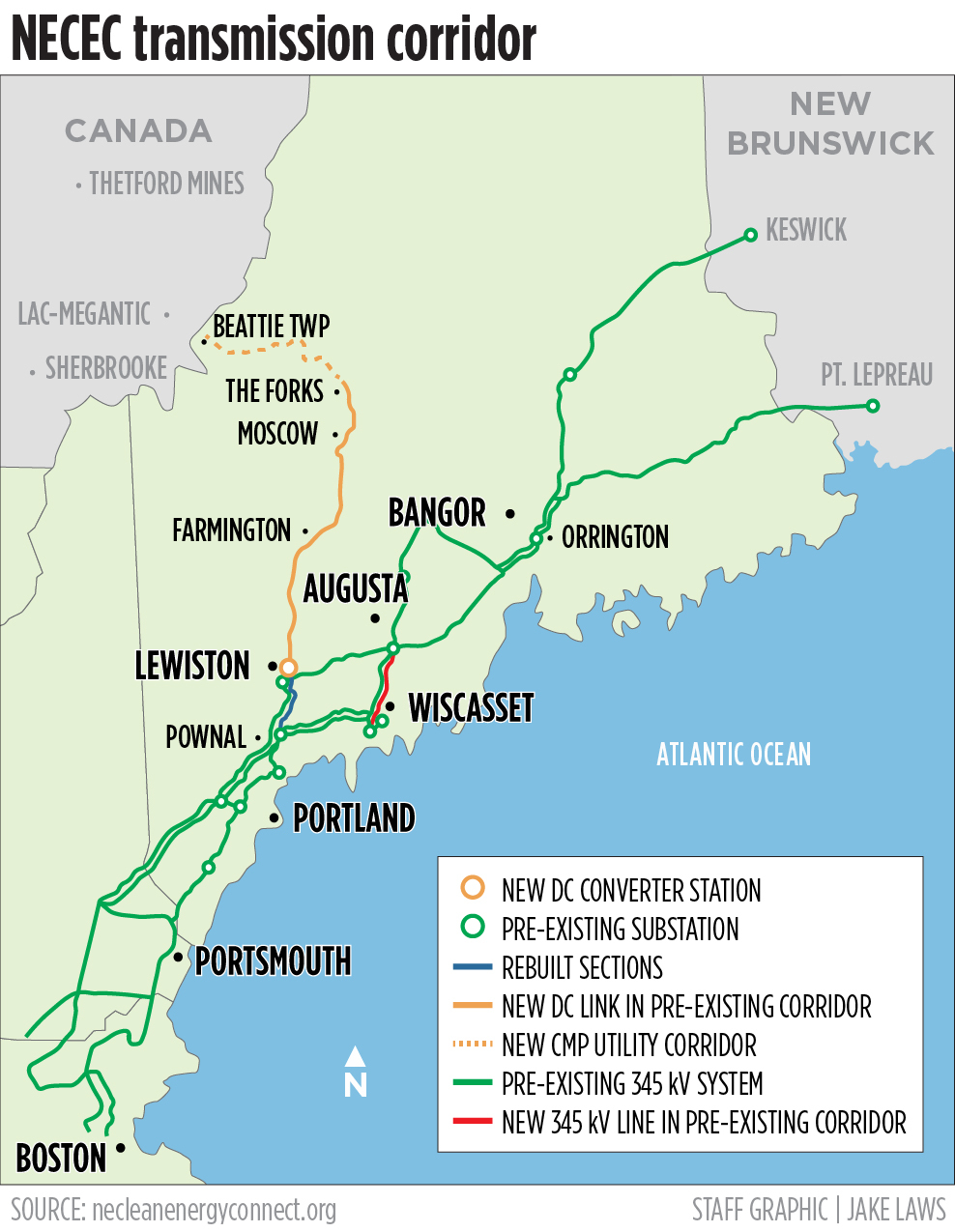
Avangrid, parent company of NECEC and Central Maine Power Co., told the Maine Public Utilities Commission early this month that the line would begin carrying commercial electricity Friday “unless the parties — NECEC, the Massachusetts Electric Distribution Companies, and Hydro-Québec — mutually agree in writing to an alternative date (such as a slightly earlier start).”
Lynn St-Laurent, a spokesperson for Hydro-Québec, confirmed the Friday goal in an email Tuesday afternoon. The company is “taking care that all technical prerequisites are met,” she said.
The line has been carrying small quantities of electricity for weeks, as construction and final testing concludes, according to data provided by ISO New England, which oversees the region’s electric grid.
Since its proposal in 2017, the project faced heavy opposition from environmental groups, which argued that its construction would disrupt the surrounding environment and wildlife.
Advertisement

Construction of the large New England Clean Energy Connect hydropower converter station off outer Main Street in Lewiston is seen in its final phase in February 2025. The transmission line is expected to begin commercial operation Friday. (Russ Dillingham/Staff Photographer)
The project’s fate was put to voters in a 2021 referendum. During the campaign, proponents and opponents spent a combined $100 million to sway opinion, setting a new record for ballot questions in the state.
Voters decisively sided against the project, but Avangrid argued that the referendum’s retroactive approach was unconstitutional. The court ultimately sided with the utility.
Related
Maine regulators approve conservation plan, allowing completion of controversial NECEC line
In response to environmental concerns, regulators at the Maine Department of Environmental Protection required NECEC to conserve 50,000 acres near the line. Regulators approved the company’s proposal in November, clearing the project’s final hurdle.
Avangrid says the line will reduce energy costs in Maine by between $14 and $44 million. In Massachusetts, where most of the power will end up, the projected savings are about $150 million, according to Avangrid’s parent company, Iberdrola.
A spokesperson for Avangrid declined to comment on the project Monday.
Copy the Story Link
Tagged: Central Maine Power Co., electric bills, energy costs, environment, lewiston maine, maine department of environmental protection, NECEC

Daniel Kool is the Portland Press Herald's cost of living reporter, covering wages, bills and the infrastructure that drives them — from roads, to the state's electric grid to the global supply chains... More by Daniel Kool
Source: Press Herald
Locations: Portland, Lewiston
Region: Central